May 11, 2011

Horrors of the Hairy Frog


Today's guest is the Hairy Frog, Trichobatrachus robustus. This frog has a few things that make it rather unique. The most obvious is the hair, which frogs generally aren't supposed to have. Fortunately, it isn't really hair, just "threads of vascularised skin [grown] during mating season". I'll be honest, I don't exactly know what that means either.

But that isn't what really gets the Hairy Frog onto this page (even though it generally would be enough). No, it gets to join this page because of the trait that gets it its other common name, the Horror Frog. Now, a decent number of frogs have some sort of claws on their feet for defense. The Horror Frog doesn't. When it needs to defend itself, it actively breaks bones in its feet, then pushes the sharped, broken ends through its skin to use as makeshift claws. See the picture below.

According to newscientist.com,

At rest, the claws of T. robustus, found on the hind feet only, are nestled inside a mass of connective tissue. A chunk of collagen forms a bond between the claw's sharp point and a small piece of bone at the tip of the frog's toe.

The other end of the claw is connected to a muscle. Blackburn and his colleagues believe that when the animal is attacked, it contracts this muscle, which pulls the claw downwards. The sharp point then breaks away from the bony tip and cuts through the toe pad, emerging on the underside.

Here's a picture of the end result, from the outside.

Thanks to Cracked.com (NSFW/18+) for alerting me to this bizarre frog.

Tkrausse

May 9, 2011

Another bad hair day


I thought I knew a lot about sloths. I used to work with two-toed sloths as a zookeeper. I know that the closest relatives of sloths are the apparently very different anteaters and armadillos, and that together they all make up an order called xenarthra. Hey, I even wrote a mystery with a sloth in the title, a sloth on the cover, and where important plot-related peril happens to sloths.

And yet somehow I only recently stumbled upon this species, the maned sloth. It's reportedly the rarest species, so I guess that's how I missed it.

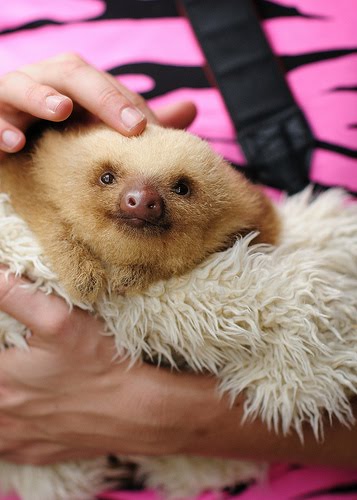
Sloths are definitely not conventionally attractive, but I think they're the cutest things ever - especially the babies. I mean, if this doesn't prove that the world needs the word "ugdorable" I don't know what does:


That maned sloth, though...

But hey, maybe all it needs is a good makeover. It doesn't look too bad in this artist's rendering:

You can have some ugly animal craft fun by downloading that cutout-and-assemble maned sloth at the Yamaha website (I am not making that up).

You can also read more about this sloth and other xenarthans at - where else - xenarthrans.org, the website of the conservationists who specialize in them. And see more pictures, including some very clear views of that unfortunate hairstyle, at the website of photographer Kevin Schafer.

-Slothfully,
Wombat (No Relation)

Two-toed sloth baby by Flickr user justonlysteve.

May 6, 2011

A True Illustration of "Eyes Glazing Over"

Finally, someone to accurately portray how my eyes looked during operating systems class!

Photo by Toby Hudson

This obliging masked lapwing (shown below enjoying a juicy worm) has provided a prime depiction of the nictating membrane, or third eyelid, that provides eye moisture and protection to various animals while still maintaining visibility. The lapwing uses its nictating membrane to blink but closes the whole eyelid to sleep.


Photo by Toby Hudson

Shown here is a chicken blinking:

Photo source: Wikimedia Commons

A red-tailed hawklet winks for the camera:

Photo by flikr user ronmdon

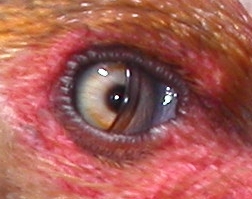
And yes, this is the same nictating membrane you have seen up close and personal on your pets:

Photo source: Washington State University

--------------
Thanks to alert reader JIP for bringing this terrifying horizontal eyelid to our attention. Happy 25th birthday today!

May 4, 2011

Origins of the Pekingese: A Love Story

Ah, the Pekingese.

Photo source: Petfinder.com

The ancient toy dog breed beloved of the Chinese Imperial court. Whence came its flat face and bow-legged gait, characteristics of the breed for over 2,000 years? According to legend,

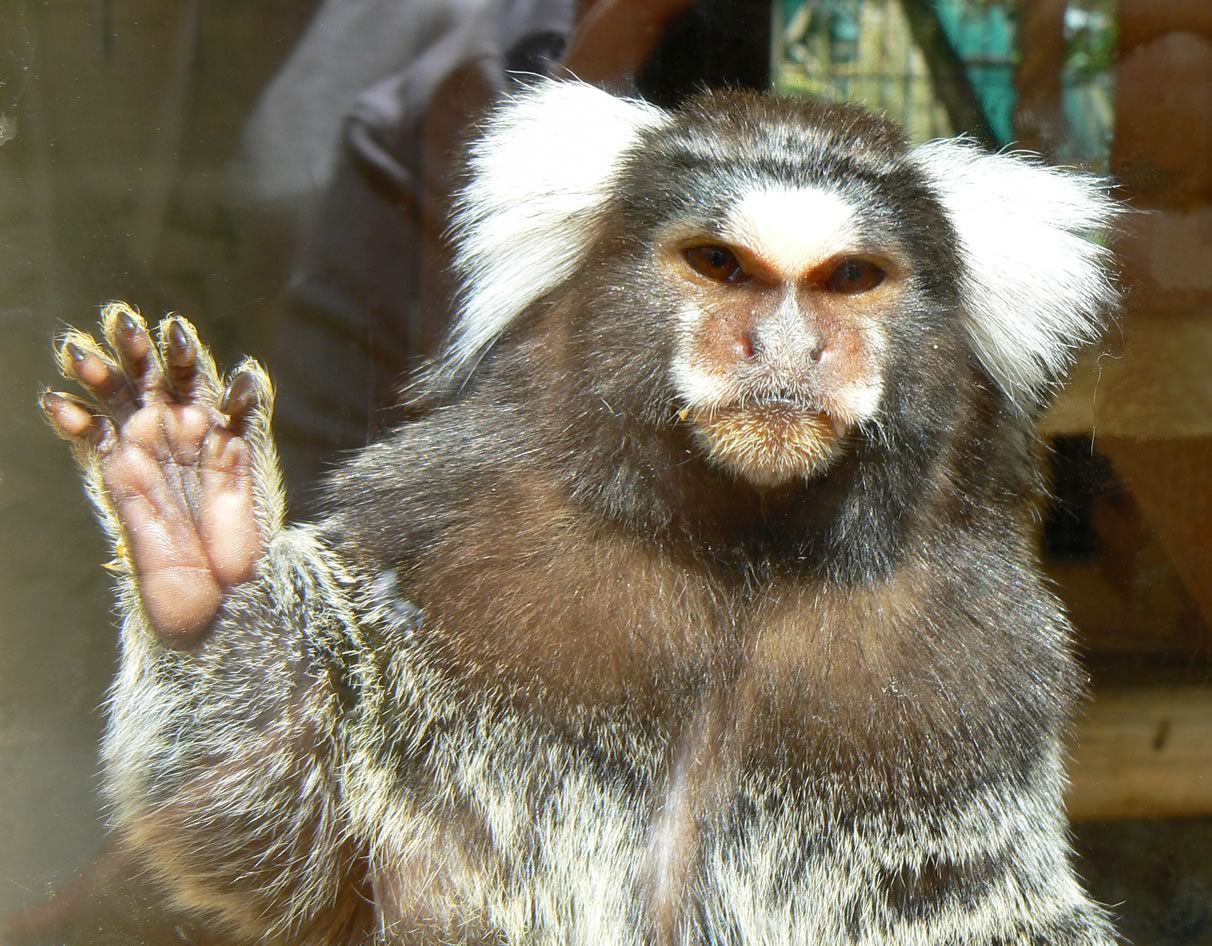
A lion and a marmoset fell in love. But the lion was too large. The lion went to the Buddha and told him of his woes. The Buddha allowed the lion to shrink down to the size of the marmoset. And the Pekingese was the result.


Photos courtesy of My Opera and the Amazona Zoo

Photo source: Good Dog Care

A less common version of the story substitutes a butterfly for the marmoset, but I think the family resemblance is more obvious in the marmoset version.

Apr 27, 2011

Happy World Tapir Day!


Every year, April 27th is World Tapir Day, dedicated to raising awareness of one of the most wonderful non-conventionally-attractive mammals in the world. This photo is a Baird's tapir, my favorite, which lives in Mexico and Central America. (Well, this particular one lives in New Jersey, but you get the point.) There are three (possibly four) other species, all from the New World except for the Malayan tapir, the black and white one that you are probably familiar with, if you're at all familiar with tapirs.

If you're not familiar with tapirs, of course, you're probably bewildered. People often guess that they are anteaters or some kind of pig. In fact their closest relatives are horses and rhinos, but aren't they so much more wonderful?

You can find out if your local zoo is having an event at the World Tapir Day Facebook page. Elsewhere on the web, you can find a ton of information (and an excellent gift shop) here. You might also like this webcam where you can sometimes see some Brazilian tapirs snoozing.

Celebrate!
- Wombat (No Relation)

Apr 25, 2011

Ugh, monday


If you thought the birds in the last post were having a bad hair day, check out this Phillipine eagle. At least those vultures looked like they'd just rolled out of bed, giving them an excuse. This guy looks like he's worked at it, and this is still the best he could do.

This species is reportedly one of the most critically endangered in the world, but I am also a little worried about this particular specimen. A resident of a conservation center, he's been given the name Binay, because he's been "adopted" by the Phillipine vice president Jejomar Binay.

You'd think this would give him a leg up in life, but a little research revealed that the last vice president also adopted an eagle.... which died. But maybe the new VP can at least get this guy a hairdresser before it's too late?


Thanks to the Telegraph's Pictures of the Day.

Apr 23, 2011

The Egg-cracking Egyptian Vulture

Meet the Egyptian vulture, also known as "Pharaoh's Chicken": the bird with a Ph.D. in egg-eating.

Photo by Ron Saldino

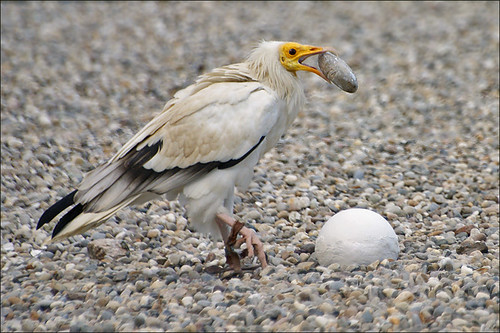
Egyptian vultures are best known for their technique of throwing or dropping stones on eggs to crack them, placing them among the few bird species to make use of tools.

Photo by Flikr user Foto Martien

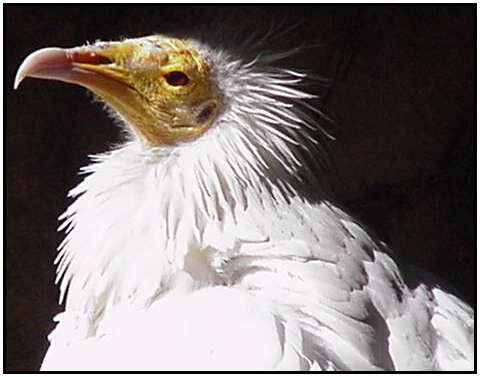
In addition to eating the eggs of ostriches and other large birds, Egyptian vultures also favor carrion, insects, decaying vegetable matter, and the feces of humans and other mammals.

Photo by John Wurth

In answer to the pressing question of whether the use of stones is an instinctive behavior or a technique acquired from watching other vultures, authors Thouless, Fanshawe, and Bertram reported the following in the International Journal of Avian Science:

There was no evidence of cultural transmission for stone-throwing through copying experienced birds. A naïve captive-reared bird threw stones once an Ostrich egg had been linked with a food reward. The origins of aimed stone-throwing are probably related to the unaimed throwing of small eggs, since the actions are similar, and all tested birds strongly preferred to throw rounded or egg-like stones, rather than jagged ones, at Ostrich eggs.

Photo by Linda Schueller

Photo source: Wildlife Extra

This video shows the Egyptian vulture plying its egg-opening technique (though this is only part of the multi-act drama that unfolds).


-------
This post is dedicated to reader OMBF's nose, whose size has drawn comparisons to a beak.

Apr 11, 2011

Rock vomit!


I am not making this up: Rock vomit is the nickname scientists have given to the sea squirt Didemnum vexillum. It's become an invasive species in various parts of the US - found on the West Coast and in New England, it was most recently discovered last June in Alaska. Here's a closeup of another colony of the stuff from the USDA invasive species website:


Scientists working on an eradication plan in Alaska are concerned because along with the ugly name and ugly appearance, this creature has ugly habits. "It smothers other creatures while producing acidic toxins that in turn prevent anything from growing on it," a NOAA biologist told reporters.

This behavior can kill many other animals that we like a lot better, including fish that are of commercial importance, reportedly since it interferes with their ability to feed. I think what they mean by that is that the fish can't get at their food, but you have to wonder, is it also because once they see this thing, they're too nauseous to eat?

Queasily,
-Wombat (No Relation)