

Isn't that an endearing picture of motherly love? Even if it is so ugly that it makes you a little queasy?
You didn't know that worms take such good care of their offspring? Well, that's not a worm. It's a caecilian, which is a type of amphibian. Believe it or not, this animal is actually a limbless, burrowing cousin to frogs, toads and salamanders. And they not only look quite different their relatives, they have rather different reproductive strategies. About 75% of the species give birth to live young, and the rest, like this one, lay eggs that are guarded by the female till they hatch.
This particular caecilian is one of seven new species that scientists discovered recently in India, which are members of an entirely new family. You may love ugly animals, but I'm betting you can't beat these researchers: they spent a total of 1,000 man-hours digging to find these creatures. Now that's devotion.
-Wombat (No Relation)
Feb 23, 2012
Ugly devotion


Jan 20, 2012
The Japanese have a word for it.

Today I visited some lovely acquaintances of mine who are smooth-sided toads (Bufo guttatus) like the one in this rather dreamy portrait by Brian Gratwicke, conservation biologist at the National Zoo.
I was reminded of this blog post, in which I learned that if I were Japanese, I wouldn't have had to make up a word for "ugdorable." Here's what author Matt Alt says in the post about what he calls the age-old "love-hate relationship" between the Japanese and toads:
Sure, they're warty and bumpy and hang out in slimy dark places, but there's something about those beady little eyes that demands a certain amount of affection.
The Japanese actually have a word for this type of cognitive dissonance: it's called kimo-kawaii: cute and gross, all at the same time.
Not surprising I guess that this country which is a world leader in cute had a handle on this concept before the rest of us.
-Wombat (No Relation)
Nov 18, 2011
Slimy and ugdorable hellbabies!

Today I met these young hellbenders. Aren't they cute? Look at their beady eyes and wrinkles! Look at their tiny little toesies!
These guys are about two years old and maybe eight inches long. I'm not sure, I was too busy squealing to measure them. Adult hellbenders are about two feet long and look a lot like miniature Japanese giant salamanders, but live in the eastern United States. And they're colloquially called "snot otters." It doesn't get any better than that, right?
When you're done cooing and squealing, read more at Hellbenders.org.
-Wombat (No Relation)
Jul 17, 2011
Ugly winners

The conservation organization Amphibian Ark just concluded a photography contest for its calendar for next year, and I'm pleased to report that ugly frogs were not entirely overlooked. That's a shovelhead treefrog, a species I was previously unaware of. And our old friend the purple frog of India got an honorable mention:
If it had been an ugly contest instead, that one would deserve a grand prize.
-Wombat (No Relation)
May 17, 2011
Lake Titicaca Giant

When Jaques Cousteau led an expedition to the lake, he found "thousands of millions" of these frogs cruising it's depths. He reported some weighing as much as two pounds and stretching out to nearly twenty inches. But local fishermen say the days of those behemoths are gone. They're smaller now, and harder to find.CITES has listed them as 'vulnerable.' And why? One of the main reasons is that geniuses in Lima, Peru, have decided that if you make a drink with some of this frog's juice it will act as an aphrodisiac.

Now, it's true that Telmatobius culeus means "aquatic scrotum" (not a recommended band name, at least in Latin) But take one look at the frog and you'll see why it received that charming moniker. Believe me, though I don't know from personal experience, drinking aquatic scrotum juice will do nothing for your own nether regions.
Photos via Ever So Strange
May 11, 2011
Horrors of the Hairy Frog
 Today's guest is the Hairy Frog, Trichobatrachus robustus. This frog has a few things that make it rather unique. The most obvious is the hair, which frogs generally aren't supposed to have. Fortunately, it isn't really hair, just "threads of vascularised skin [grown] during mating season". I'll be honest, I don't exactly know what that means either.

Here's a picture of the end result, from the outside.At rest, the claws of T. robustus, found on the hind feet only, are nestled inside a mass of connective tissue. A chunk of collagen forms a bond between the claw's sharp point and a small piece of bone at the tip of the frog's toe.
The other end of the claw is connected to a muscle. Blackburn and his colleagues believe that when the animal is attacked, it contracts this muscle, which pulls the claw downwards. The sharp point then breaks away from the bony tip and cuts through the toe pad, emerging on the underside.

Jan 8, 2011
Frogs make desperate attempt to associate themselves with trendy bestsellers?

I know, that frog is lovely. You think there's no way it could belong on this blog. But hang on a minute.
This is a newly discovered species from Vietnam called the vampire flying frog. The "flying" part is because it can glide from tree to tree, using the unusual amount of webbing between its toes.
The other part of the name has nothing to do with the adorable adult in the picture above. It's based on a feature of the tadpoles that the original paper delicately calls "a pair of keratinized hooks on the lower labium that face away from the mouth." That is, this baby has FANGS:
Just so you know, normally, tadpoles do NOT have fangs. The scientists have no idea what function they serve. You'll be relieved to know that they don't suck blood, since tadpoles are vegetarians. Other than that, it's still a mystery. Maybe frogs are trying to stem the tide of extinction by hopping on the "Twilight" bandwagon?
But, seriously, this is freaky. In my last post we saw a mammal with scales. Now, we've got a tadpole with fangs. Don't these animals read the textbooks???
-Disconcertedly,
Wombat (No Relation)
Dec 18, 2010
No Dissection Needed


Nov 4, 2010
The Amazing Axolotl


Oct 22, 2010
You can burrow but you can't hide

We've seen the purple frog of India a couple of times before (here and here). But I have to say, I looked at those pictures and thought, something has to be wrong. Frogs are usually cute, or even pretty. Even toads have a kind of lumpy aesthetic appeal. Surely the photographers caught those frogs at an awkward angle, or a bad moment.
But if there was ever a glamour shot of this species, this has to be it, and there is no denying its majestic hideousness. It is appalling in all its proportions. It even looks like it would feel nasty, and I'm speaking as someone who has picked up frogs hundreds of times in the course of a career.
This frog was only discovered by scientists in 2003. It was overlooked because your only chance to see it is two weeks of the year in the monsoon season. The rest of the time, it hides underground. Poor thing, now I understand why.
Sympathetically,
Wombat (No Relation)
(Picture from a rather odd slideshow of ugly animals at news.com.au. What's ugly about pygmy marmosets???)
Aug 13, 2010
Resenting the Olm

The olm is another one of those uglies who's really got it all. This aquatic cave salamander is naked, blind, elongated, vaguely obscene, and keeps its juvenile feathery, bloody-looking gills for the whole of its remarkably long life.
The olm lives in caves in Slovenia and Croatia, and the Slovenians seem to appreciate their uglies: they've put this critter on a coin:
While small animals generally have shorter lifespans than big animals, the olm has been recorded as living to 70 years of age, and recently published research suggests that they can live past 100.
I can't say I'm actually happy about this fact. I get annoyed enough when an animal has more Facebook friends than I do. The last thing I want to hear about is more animals that live longer than I probably will. I have places to go, books to write, cookies to eat... is the olm really going to make better use of all that time?
Read more about the olm and the scientists who study it at the excellent blog Not Exactly Rocket Science.
Crankily,
Wombat (No Relation)
Aug 9, 2010
Satisfied Frog is Satisfied

I came across this picture in my RSS feed one morning. It was posted on Fork Party (some NSFW content).
I believe this is a white's dumpy frog, but I may be wrong. I'm an entomologist, not a frog expert. If I'm wrong, please correct me in the comments.
These frogs are all the proof I need for global warming. I mean, how else can a frog melt like this?
theeternalmusic.com
Aug 5, 2010
Happy Hanzaki Matsuri!

Are you getting ready for the biggest ugly animal holiday anywhere? You might still have time to get a ticket to Japan in time for Sunday, when the village of Yubara Onsen holds its annual Giant Salamander Festival.
The festival is held every August 8 and begins with a parade led by the two GIANT giant salamander floats in the photos.
If you can't get there for the festival, they have an aquarium where you can view actual live giant salamanders year-round. And of course if it's closer, don't forget that you can celebrate the holiday with a trip to see the giant salamanders at the National Zoo in Washington, DC.
With huge, slimy enthusiasm,
-Wombat (No Relation)
Photos by Flickr user world_waif and from the blog Alt Japan, where you can read more about the festival.
Jul 24, 2010
An Ugly Welcome

This week the National Zoo in Washington, DC held a VIP reception to welcome representatives of a unique species from Asia. It was covered by TV and newspapers and attended by foreign dignitaries.
And no, it was not about pandas! For a change, the ugly got its turn in the spotlight.
The event was the official opening of the new exhibit and breeding facility for Japanese giant salamanders. Unlike the little hand-held critters that probably come to mind when you think of salamanders, these guys can grow to be five feet long and over fifty pounds. The Japanese have designated them “special natural treasures,” recognizing that just because you look like a pile of mud and pebbles at the bottom of a stream, that doesn't mean you're not precious.
The zoo hopes to be the first in the United States to breed the salamanders. In the wild, their courtship is itself rather ugly, since males can fight for mates so viciously that some die from their injuries. Fortunately there's no need for that at the zoo, so perhaps it will be more like the cartoon produced for the occasion:
See the rest of the comic here and more pictures here.
Ceremonially,
-Wombat (No Relation)
Mar 30, 2010
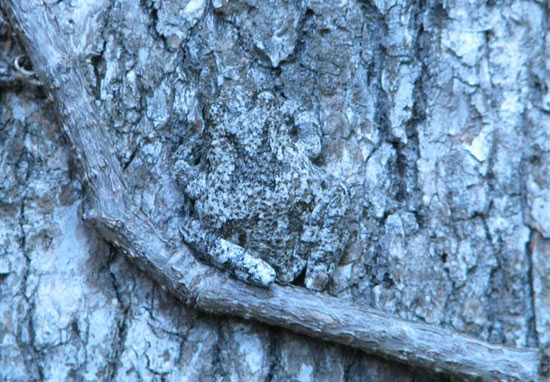
Camouflaged Spread
Jaden sent us this link from ThisBlogRules.com. Enjoy this spread of camouflaged creatures, including a crab spider, a scorpion fish, a stone fish, and an orchid mantis. Thanks, Jaden.




Mar 7, 2010
Chicken Frog
Photo via BBC.co.uk Weighing in at 1kg, the mountain chicken frog is one of the largest frogs in all the world. It's definitely the largest amphibian in the Caribbean.
Feb 17, 2010
After Midnight
Thanks for the photo, Steve.

Feb 14, 2010
Taken in by Green
This photo has been featured all over the place, like the Encyclopedia of Life and Science Daily. It's a cropped image that Matt took of his European green toad (Bufo viridis).

Feb 3, 2010
Cheshire Frog
 A Cheshire frog looming out of the darkness on an overhead tree branch. Definitely more freaky than a Cheshire cat. Lewis Carroll probably made the right choice.
Dec 28, 2009
Frog Mantra
I know how you feel, little frog. The shadows have grown long, your belly is full, your eyelids are heavy. Sleep, little frog, sleep. Pay no attention to the cold linoleum beneath you, or the fact that your handler has left you out in the open, exposed to sun and predators.
Just sleep. It'll all go away.
...sleep...
That's similar to the mantra I hear in my head as my work day comes to a close and there are more things not done than got done.
Photo source: Jason Meinig


 Chinese
 French
 German
 Italian
 Japanese
 Korean
 Russian
 Spanish

