
Want to read an article that will have you leave you squirming? Then check out this link, brought to us by Casey. It shows how in nature there are parasites, and then there are parasites who up the ante. And the world is more zombie-rich for it.
Behold the alien beauty (I'm stretching here, for the sake of this post) of a Costa Rican orb weaver known as Plesiometa argyra. This spider is known for its perfectly symmetrical and round webs.
Ah, but what happens when a parasitoid wasp comes along and stings the spider? The spider goes comatose for about 15 minutes and wakes up and resumes its normal routine. But the spider is unaware that the attack it just *survived* resulted in it being inject with a wasp egg.
A little while later, that same little waspling will hatch and begin dining on the spider. Typical parasite behavior--until it gets time for the little larvae to pupate. It enlists the spider's help in that, by making it a zombie. The larvae hijacks the spider's brain and induces it to ply its web-weaving skills at pupae making. The orb weaver literally spins a cocoon for the larvae and suspends it above the forest floor, safe and out of the way of would-be predators. See the photo below: the left is of a normal web, the right is a zombie web.
And what does the larvae do to show its appreciation? It drains the spider dry and tosses aside its shriveled carcass. I'm afraid that's what my kids will do when they've used me up. I've already got a head start on the zombie thing after a couple of weeks of sleep deprivation.
Nov 3, 2008
Zombie Spiders


Jul 21, 2009
Phorid Horror
There are many ways to enter this humble world of ours. Some are more dramatic than others, but not many can surpass the entrance of a young phorid fly for sheer triumphant drama.
In this sequence of photos (via National Geographic) you'll see a female phorid fly hovering over a fire ant, who gets pierced by her needle-sharp ovipositor. The egg now planted inside the ant will soon hatch, and the larva will migrate to the ant's head, where, over the course of a few weeks, it will suck up the ant's brain. What is left of the ant after all this? A zombie ant, of course.
The phorid fly larva then commandeers the ant, and can even force it to wander away from the ant hive to protect the ant from the other ants who might begin to get suspicious of the zombie ant. Once in seclusion, the larva pops off the ant's head and proceeds to emerge. How's that for drama? The insect world provides us with horror stories better than most human minds can conceive.
Thanks for the article, Moneca.


Oct 1, 2010
Triple threat

Starting off October with three creatures so scary, you should make plans to dress up as them for Halloween. Look at those gaping maws like the mouth of hell, plumage like strips of rotting flesh, and cold, dead eyes! These must be zombie birds, right? Yet the Telegraph's Pictures of the Day claims they are perfectly innocent baby Malay night herons. I'm not sure what to believe.
-Locking the door and drawing the blinds,
Wombat (No Relation)
Nov 1, 2009
Libersat
This is really great news for cockroaches in the French Polynesian islands. We finally have a cure for you zombie cockroaches! That's right, get the word out.
If you're a roach and you've been stung by a jewel wasp with the intent of zombifying you so she can drag you off to feed you live to her young, you're not necessarily finished. No, all you need is an injection of Libersat (a mimic of the neurotransmitter octopamine), and you can be revived.
Kind of like those of us humans who have to carry around an epinephrine injection to ward off anaphylaxis, I suggest you roaches start carting around Libersat. It just might save your life.
Thanks for the link, Moneca.
May 14, 2008
Miscreant Youth
 Imagine yourself working your fields, doing back breaking work day after day in the hot sun, trying to coax your beets to grow. Just as the sun reaches its zenith, you stand upright to stretch your aching back. You cock your head at the sound of approaching rain.
Whaa..?
You look to the horizon and see what looks to be a fast approaching, swirling cloud of blackness that blots out the sky. But what you're looking at is a locust swarm--and the utter ruination of your beets.
A locust swarm can be comprised of billions of individuals and can eat tens of thousands of tons of vegetation each day. But why in the world do these normally herbivorous locusts seem to spontaneously swarm? It's because of their miscreant youths.
A new study posits that when times get tough, the tough become cannibals. This phenomenon seems to be isolated to the flightless youth, who turn on each other in a bid for locust flesh (oh, if only locusts could make zombie movies...). This cannibalism triggers fear and flight reflexes in the other youths, who then continue this pattern of fear-driven flight quite literally when they gain their wings (they earn their wings by doing a good deed). Thus is a swarm born. Thus we have the genesis of the swarm. Thus is the root of the swarm discovered. Thus...sorry.
It's comforting to know that most species of animalia have trouble with their teenagers. Except for bugs that go through a pupal phase--that's the way to do it.
Thanks for the link, Ida.
Photo source: AP via BBC News
Mar 14, 2010
Plush Spider
Photo source: Ge van 't Hoff

Dec 4, 2010
Killed by Behavior-modifying Parasite Fungus
There has been a rise in our fascination in zombie fiction and movies lately. I think such tales strike a deep chord in our psyche. But for much of the animal kingdom, such tales aren't fanciful. They're an everyday occurrence.

Oct 26, 2008
Body-snatching Barnacles and Zombie Crabs
I stole the title to this post because I loved it so much (and I couldn't think of something better). Turns out not all barnacles are conical-shelled crustaceans that began life as free-floating plankton. Some barnacles are the scourge of any crab they encounter.
When the female Sacculina barnacles invades a crab's body, she does so in an amorphous gelatinous form. She then sends roots throughout the crab's body and begins to feed on it while she grows into a tumorous growth. She even carves out a little spot (the barnacle equivalent of a studio apartment) for the male Sacculina so that she might have baby Sacculinas. But the barnacle doesn't stop there.
Photo source: hku.hk She seizes control of the crab's mind and forces it to do her bidding. The crab ceases to grow and looses the urge to mate. Instead, it unwillingly devotes itself to caring for the barnacle's eggs, using all of its time and resources to do so (disciplining the barnacles youngsters when they get rowdy, reading to them, singing lullabies just before nap time, etc.). The barnacle even alters the physiology of a male crab so that it becomes a female, so that it might better tend to the eggs.
Come on. I know all creatures need to make a living, but some just take it too far. Some parasites manage to be beneficial, and some become tongues. This one just owns its host in every conceivable way and then discards it. My neighbor has a mooching, parasitical son, who I now suspect might be a variant of the Sacculina barnacle.
Thanks for the link, anonymous.
Mar 16, 2011
Poof Go the Spores
That's right, here's yet another tale of critters getting zombified by a parasitic something or other. In this case, it's a fungus that infects a tropical carpenter ant, coerces it to climb 25cm up a plant, face NNE, latch onto the plant with its mandibles, and then die. The fungus then sprouts the twiggish growth you see below, and *poof* go the spores (a great band name, if I do say so myself).
Thanks for the link, Kris. I'll be sure to skip the mushrooms on my pizza tonight. You can never be too sure.
Photo source: Pete Huele via CBC

Sep 13, 2011
Zombie caterpillars rain death from treetops!

That's the headline (well, without the exclamation point) from Live Science. It's a report of some research that apparently has significance if you care about the specifics of how genes work. But it's also full of riches if what you're interested in is ugly animals and ugly animal behavior.
That's a close up of the face of a gypsy moth. Lovely, right? Also badly behaved. As an invasive species introduced to North America, gypsy moths eat the heck out of our trees.
But when you're mad at gypsy moths, you can take pleasure in thinking about a horrific virus that infects them. It changes their behavior, making them climb to the treetops when they'd normally be hiding in a protected spot. It also stops them from molting, so they'll still eat and grow bigger. Soon they die, and that's when the fun really starts: their bodies liquefy, spewing virus-laden goo all over the tree and through the air to infect more moth victims.
Foresters hope that understanding this virus may help them to control the invasive moths. But it may have implications for us as well:
"Who knew that a virus could change the behavior of its host?" study author Jim Slavicek, of the U.S. Forest Service, said in a statement. "Maybe this is why we go to work when we have a cold."
-barring the doors and windows,
Wombat (No Relation)
Mar 18, 2008
Off the Florida Coast
Peer sent me this video of an unidentified sea creature off the Florida coast. Any marine biologists care to ID it for us? It might be, as Peer pointed out, a strand of zombie intestines. But that's just a guess.
Aug 29, 2009
Primitive Planarian
Photo source: Georgia University FACES Should you stumble across one of these creatures, which are rare in most parts of the US, you have one of three options. 1) Resign yourself to the fact that you're the sorry sap at the beginning of an alien invasion that has the misfortune of having made first contact, and you'll be consumed and rendered a zombie, or 2) simply shrug, smash it, and move along, or 3) do a bit of investigation and find out what it is.
If you choose that last option, you'll discover that you have indeed encountered an invasive species (unless you're in east Asia), one that has made its way around the world in nursery pots (or in human spinal columns...). You've encountered a Land Planarian (which happens to be a great name for an alien race).
These primitive flatworms have no circulatory or respiratory system, and no skeletal structure. They don't have eyes, and their mouth, which is halfway down their belly, also double as their anus (which I've found to be true among quite a few humans, too). They ambulate by gliding upon a bed of mucus of their own making, and they dine on earthworms, slugs, and human happiness. They're harmless, unless you are a happy human, or an earthworm (the planarian will attack prey 10-times its size to suck out worm juice).
Last but not least, they can procreate by laying eggs, or by budding, or by simply squeezing off part of its tail, which will then sprout into a new planarian.
Thanks for the planarian, David.
Mar 3, 2006
Identity Crisis
The tapir looks like a creation of Dr. Moreau. This sleepy specimen looks like some cross between an elephant, an anteater, a mountain lion (look at that tawny coat), a pig, and might even have some koala in it. I can't quite peg the ears. This creature's ugliness doesn't have a cringe factor; it just gives you that double-take, 'I don't know what to make of it' feeling.
Their alien looks makes me wonder why this animal hasn't been made the lead character on a Saturday morning cartoon.
Thanks for the great photography, Zombie Squirrel. Check out his other work here.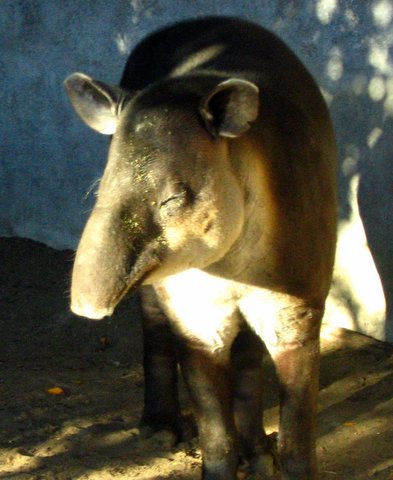


 Chinese
 French
 German
 Italian
 Japanese
 Korean
 Russian
 Spanish

